Monday, August 20, 2018

Easter Island's new Residency Law

On August 1st 2018, the visit of Chile's President, Sebastian Piñera, was timed to coincide with the fist day of the application of the Residency Law for Easter Island that the Chilean Senate and Congress had approved earlier this year.


For the visitor who plans on fulfilling their dream of setting foot on the enigmatic island, you will notice little change. On check-in at Santiago airport everyone is asked to fill in a piece of paper with the details of their trip: length of stay, accommodation etc., and this is checked again as you board the plane.


The key points of this new law is that no-one can stay stay on the island for longer than 30 days, without being a prior resident or having a defined work contract.  This isn't aimed solely at foreigners, but at Chileans too, which has created some hard feelings on the mainland, since Easter island still depends enormously on Chile for nearly everything.

However something had to give, and in the 20 years that I have been here, the local population has risen from 3,700 to over 8,000 people, and it was only getting more popular for people to want to move and live here.  The roads and infrastructure could no longer handle all of the people, and basic services such as the island hospital were buckling under the demand.

This new law would have ideally come about 10 years ago, but congratulations must be given to the island authorities who have followed this through until now. 

Friday, August 3, 2018

Presidential visit

On August 1st, the Chilean President Sebastian Piñera spent 24 hours on the island, and his whistle-stop tour included the signing of 3 important law changes that will affect the future of this island.


Firstly, he confirmed that a new law was in process to change the island's official name from 'Isla de Pascua' (Easter Island in Spanish) to Rapa Nui, one of the island's Polynesian names that has long been the preferred nomenclature for the island's residents. There is a never-ending argument amongst academics as to the 'original' name of this island, if indeed anyone actually knows it, but this is an important recognition of the island's Polynesian roots.

Secondly, he signed the bill for the introduction of the new Residency Law, which as of August 1st 2018 limits the length of time that visitors and any non-residents can stay on the island. See my subsequent post about this, since it is one of the most significant changes to affect the island in recent history, and is a long-overdue solution (hopefully) to the island's growing population.

Thirdly, he met with the 6 new local councillors who will make up the island's ocean committee, and whose responsibility it will be to control the island's recently-designated MPA (Marine Protected Area). Easter Island's MPA was created in 2017, and covers an area of 740,000 sq. km - one of the largest in the world.

All in all a very productive visit by the Chilean leader!


Thursday, July 26, 2018

New (old) planes for Easter Island

Given the distances involved with flying to Easter Island, the type of aircraft used on the route has always been an important issue, both in terms of the number of people it can accommodate, and the level of comfort it provides for the 5.5 hours of flying to the island.

Up until this month, the island had enjoyed being served by the most-modern and environmentally friendly plane in LATAM's fleet, the Boeing 787 Dreamliner:


However, recent problems that these aircraft have been having with their Rolls Royce engines, have led to many of the earlier models (of which LATAM was a fervent buyer) having to be returned and refitted, leaving them with 9 aircraft currently out of action.  LATAM have remedied this by leasing aircraft from other airlines, and for the next few months it appears that most of the Easter Island flights will be performed by these former Singapore Airlines Boeing 777-200s:


Not a problem you say, and it isn't really, except that these B777s were delivered to Singapore Airlines in 2001, and as far as we can see, no upgrades have been made to their interiors since then:


Not ideal if you were looking forward to LATAM's award-winning onboard product, but the good news is that frequencies to the island haven't been affected, meaning that the same amount of visitors will still be able to make it to Easter Island during this difficult period for LATAM.  Happy flying!


Tuesday, February 18, 2014

Tapati ends in a tie...

For the first time ever in the 40+ year history of the Tapati Rapa Nui, organizers were unable to find a clear difference between this year's candidates, and a tie was called.  In a brand new format of each female candidate also being accompanied by a male 'Aito', the festival thus finished with 2 Queens and 2 Aitos:


Congratulations to Taurama Hey & Hopumanu Rapu, together with Vai A Rupe Hotus & Korike Teao for all of their work in helping to preserve this unique and fragile culture.

Friday, January 25, 2013

A new hospital for Easter Island

After years of relying on fairly rudimentary medical facilities, the Chilean Government fulfilled one of their long-running commitments to the island, and built a state of the art hospital for the residents and visitors of Rapa Nui.  President Sebastian Pinera visited the island for the first time since taking office, and officially opened the new hospital at the end of last year.


While very specialist treatments will still require travel to Santiago, the idea is that many more people can now be treated locally, as well as including a small Local Medicine department, focusing on traditional Rapanui alternative medicine.

The new hospital remains on the same site as the old one, on Simon Paoa street, but now covers an area about 4x as large, and also includes housing for medical staff. 


Sunday, December 30, 2012

Waka Tapu reaches Rapa Nui


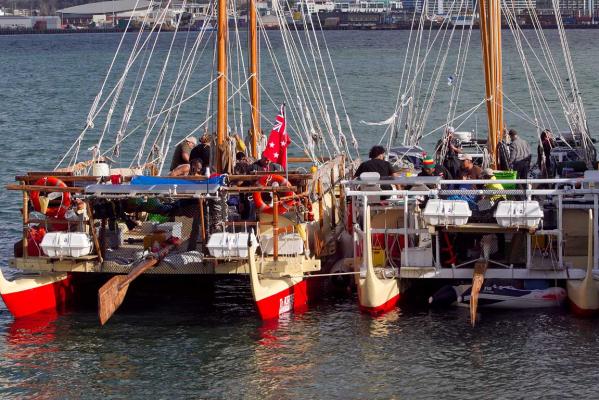
104 days after departing from New Zealand, 2 traditional Polynesian canoes and their 20 Maori crew arrived at Rapa Nui, over 10,000 miles away, in late November 2012.  Having navigated across the world's largest ocean entirely by the stars, sun, moon and ocean currents, and only stopping at Tubuai and Mangareva in French Polynesia on the way, they successfully recreated one of the possible routes taken by the Polynesians who colonised Easter Island over 10 centuries ago.  Not only was it an incredible feat by the crew, it was also an important and highly symbolic joining of two of the extremities of the Polynesian triangle.


Waiting for spare parts from mainland Chile kept the crew here on the island for almost a month, and they became well-known members of the island community.  They set sail for the return leg to Tahiti on Boxing Day, from where they'll fly back to New Zealand sometime in February.  Congratulations to the entire crew.

Tuesday, October 30, 2012

Petero Edmunds returns as Mayor

After a month of heavy campaigning by the 5 candidates for Mayor, including the incumbent Luz Zasso Paoa, municipal elections on Sunday confirmed the return to office of Petero Edmunds Paoa, who had previously held the position from 1996 - 2008.  A total of almost 2,200 voted, with Petero obtaining 937 votes (42.7%), and Luz coming second with 27.4%.


Petero currently represents Chile's Partido Progresista, having represented the Partido Demócrata Cristiano during his previous tenure as Mayor.  He also served as the island's Governor between March and August 2010 before resigning in one of the most unstable periods in the island's recent history.

Petero will be assisted by 6 Councillors (all Rapanui): Carlos Riroroko, Marta Hotus, Pedro Tepano, Yolanda Nahoe, Alberto Hotus and Mai Teao.

Congratulations to all 7, and we wish them every success for the island's healthy growth over the next 4 years.

Sunday, September 30, 2012

Ature Huki gets a facelift

Fifty-six years after its restoration by a group of islanders under the leadership of then-mayor Pedro Atan during Thor Heyerdahl's expedition to the island, the solitary moai at Anakena, Ature Huki, has recently had all of the lichen removed from its body.  In a combined effort by CONAF and a team of experts from Italy, the moai spent 2 months under wraps during the winter while the lichen was carefully removed from its surface. 
 
April 2012
  
August 2012

It is thought to be the first of many such projects for the moai, as CONAF look for the best way to preserve the moai from the harsh conditions here on Rapa Nui.


Monday, September 24, 2012

Vernal (Spring) Equinox at Ahu Akivi

The spring equinox took place here on the island at 09.49am local time on Saturday 22nd September, giving people the chance to confirm the alignments of certain moai and platforms that have long been taught.  Like most people, I had been repeating for many years the long held belief that the moai at Ahu Akivi were lined up directly with the position of the sunrise and sunset on either of the equinoxes, a fact that archaeologist/constellation expert Edmundo Edwards has long doubted.  Yesterday's sunset would appear to confirm that the alignment is close - but not exact, with exact alignment apparently taking place in a week's time.


However, much more interestingly, Edwards also stated that the moai are actually aligned to the position of the rising and setting of the Orion constellation at the equinoxes, a phenomenon that we went to test on the night of the 21st.  Aside from being one of the island's most evocative platforms anyway, on an especially clear night we were privileged to witness a truly remarkable spectacle:

   
This photo was taken at about 2.30am, and Orion's belt is just starting to appear directly behind the middle moai, with Orion's 'sword' visible over the moai's left shoulder:

Thursday, September 20, 2012

The return of the alien theories

With the airing this week of the BBC series 'Wild Pacific' in the US (previously released as 'South Pacific' in the UK), questions regarding the role of aliens in the creation of the moai reappeared in various media sources, including headlines such as 'Aliens visited Easter Island':


Aside from being so fanciful that they don't even warrant discussion, these theories are also hugely disrespectful to all of the scientific study of the past century, and even more so to the original Rapanui who carved and transported all of the statues.  While Erich von Daniken's book 'Return to the Stars' (1972) was seemingly the starting point for these theories, and the first to suggest that the islanders didn't possess the tools or the knowledge to carve the moai, it seems incredible that 40 years later these theories are still in existence, and are periodically aired on slow news days.

And while Joanne van Tilberg's recent excavations inside the crater at Rano Raraku should have been highlighted for the new archaeological information that they unearthed, most newspapers went with a completely different story: namely that this was the first proof that the 'heads' actually had bodies:


The fact that they used a photo taken in 1986 to announce this 'breakthrough' only confirms the total lack of interest by most journalists to research these stories thoroughly.  It is ironic that 2012 has been the year in which Easter Island has featured more than ever in the mainstream media, including the cover of National Geographic for the first time, and yet the quality of the reporting has been some of the very worst.


Monday, September 17, 2012

2012 - A bad year for yachts

While visiting yachts are still an unusual sight on Easter Island, there has been a steady increase over the years in the number of people choosing to visit the island in this way.  Taking at least 3 weeks to sail here from any other port, and few safe anchorages once you arrive, it's easy to see why so few people elect to cross the Pacific via this route.

However, 2012 has not only seen an increase in yacht traffic, but also the first 2 serious yacht accidents in recent history: firstly the unfortunate case in March of 'La Rose' which crashed onto the rocks approaching Hanga Piko in heavy swells, and in July the German-owned yacht 'Gen Oster', which was blown onto the rocks at Anakena.  'La Rose' was unsalvageable, and currently lies under a tarpaulin at Hanga Piko, awaiting scrapping.  'Gen Oster' is in the process of being repaired, but is not due to be seaworthy again until at least February, giving her owners an unexpected six-month stay on the island.

Photo courtesy of Christophe Conry

Sunday, September 2, 2012

The disappearance of Ovahe

Much to the sadness of everyone here, an unusually strong winter storm removed most of the sand from the island's 2nd beach, Ovahe.  Local opinion is that the sand will eventually be returned by the currents, but this certainly won't be happening anytime soon.  That said, it's not the first time that the sea has changed the appearance of Ovahe - I'm reliably informed that during the 80's Ovahe was just one bay, before the ocean removed a considerable amount of sand and the left the dividing rocks exposed.


July 2012


September 2012
Ovahe always used to be a much quieter, hidden option to Anakena, and will be greatly missed as an alternative to its larger neighbour.

Added to the lack of sand is the marked increase of flotsam and maritime junk...a worldwide issue that not even isolated islands are free from.  Previous initiatives by local groups and the Explora hotel have always kept the issue relatively under control, but with no-one now visiting Ovahe, the build-up has got to previously unseen levels:


Friday, August 3, 2012

8th Easter Island Conference

The 8th Easter Island and Pacific Conference took place in Santa Rosa, California in July 2012, offering academics and Rapanui-philes from all over the world the chance to gather and listen to 3 days of papers and presentations by some of the world's leading authorities on Easter Island and the Pacific region.


A wonderful opportunity to learn more about this fascinating multifaceted island, the conference also included papers by 2 of the island's own students, Merahi Lopez Atan and Cristian Moreno Pakarati.  It was also an excellent chance to catch up and discuss the island with old friends who visit the island far too seldom:


The 9th Easter island Conference is due to take place in Berlin, Germany in July 2015.  More information will soon be available from: www.9th-eip-conference.org