Tuesday, February 18, 2014

Tapati ends in a tie...

For the first time ever in the 40+ year history of the Tapati Rapa Nui, organizers were unable to find a clear difference between this year's candidates, and a tie was called.  In a brand new format of each female candidate also being accompanied by a male 'Aito', the festival thus finished with 2 Queens and 2 Aitos:


Congratulations to Taurama Hey & Hopumanu Rapu, together with Vai A Rupe Hotus & Korike Teao for all of their work in helping to preserve this unique and fragile culture.

Friday, January 25, 2013

A new hospital for Easter Island

After years of relying on fairly rudimentary medical facilities, the Chilean Government fulfilled one of their long-running commitments to the island, and built a state of the art hospital for the residents and visitors of Rapa Nui.  President Sebastian Pinera visited the island for the first time since taking office, and officially opened the new hospital at the end of last year.


While very specialist treatments will still require travel to Santiago, the idea is that many more people can now be treated locally, as well as including a small Local Medicine department, focusing on traditional Rapanui alternative medicine.

The new hospital remains on the same site as the old one, on Simon Paoa street, but now covers an area about 4x as large, and also includes housing for medical staff. 


Sunday, December 30, 2012

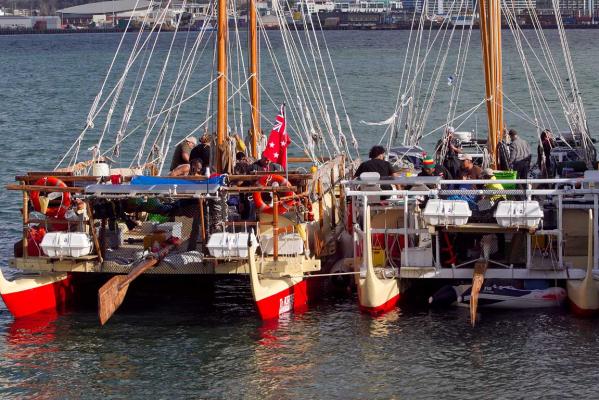
Waka Tapu reaches Rapa Nui


104 days after departing from New Zealand, 2 traditional Polynesian canoes and their 20 Maori crew arrived at Rapa Nui, over 10,000 miles away, in late November 2012.  Having navigated across the world's largest ocean entirely by the stars, sun, moon and ocean currents, and only stopping at Tubuai and Mangareva in French Polynesia on the way, they successfully recreated one of the possible routes taken by the Polynesians who colonised Easter Island over 10 centuries ago.  Not only was it an incredible feat by the crew, it was also an important and highly symbolic joining of two of the extremities of the Polynesian triangle.


Waiting for spare parts from mainland Chile kept the crew here on the island for almost a month, and they became well-known members of the island community.  They set sail for the return leg to Tahiti on Boxing Day, from where they'll fly back to New Zealand sometime in February.  Congratulations to the entire crew.

Tuesday, October 30, 2012

Petero Edmunds returns as Mayor

After a month of heavy campaigning by the 5 candidates for Mayor, including the incumbent Luz Zasso Paoa, municipal elections on Sunday confirmed the return to office of Petero Edmunds Paoa, who had previously held the position from 1996 - 2008.  A total of almost 2,200 voted, with Petero obtaining 937 votes (42.7%), and Luz coming second with 27.4%.


Petero currently represents Chile's Partido Progresista, having represented the Partido Demócrata Cristiano during his previous tenure as Mayor.  He also served as the island's Governor between March and August 2010 before resigning in one of the most unstable periods in the island's recent history.

Petero will be assisted by 6 Councillors (all Rapanui): Carlos Riroroko, Marta Hotus, Pedro Tepano, Yolanda Nahoe, Alberto Hotus and Mai Teao.

Congratulations to all 7, and we wish them every success for the island's healthy growth over the next 4 years.

Sunday, September 30, 2012

Ature Huki gets a facelift

Fifty-six years after its restoration by a group of islanders under the leadership of then-mayor Pedro Atan during Thor Heyerdahl's expedition to the island, the solitary moai at Anakena, Ature Huki, has recently had all of the lichen removed from its body.  In a combined effort by CONAF and a team of experts from Italy, the moai spent 2 months under wraps during the winter while the lichen was carefully removed from its surface. 
 
April 2012
  
August 2012

It is thought to be the first of many such projects for the moai, as CONAF look for the best way to preserve the moai from the harsh conditions here on Rapa Nui.


Monday, September 24, 2012

Vernal (Spring) Equinox at Ahu Akivi

The spring equinox took place here on the island at 09.49am local time on Saturday 22nd September, giving people the chance to confirm the alignments of certain moai and platforms that have long been taught.  Like most people, I had been repeating for many years the long held belief that the moai at Ahu Akivi were lined up directly with the position of the sunrise and sunset on either of the equinoxes, a fact that archaeologist/constellation expert Edmundo Edwards has long doubted.  Yesterday's sunset would appear to confirm that the alignment is close - but not exact, with exact alignment apparently taking place in a week's time.


However, much more interestingly, Edwards also stated that the moai are actually aligned to the position of the rising and setting of the Orion constellation at the equinoxes, a phenomenon that we went to test on the night of the 21st.  Aside from being one of the island's most evocative platforms anyway, on an especially clear night we were privileged to witness a truly remarkable spectacle:

   
This photo was taken at about 2.30am, and Orion's belt is just starting to appear directly behind the middle moai, with Orion's 'sword' visible over the moai's left shoulder:

Thursday, September 20, 2012

The return of the alien theories

With the airing this week of the BBC series 'Wild Pacific' in the US (previously released as 'South Pacific' in the UK), questions regarding the role of aliens in the creation of the moai reappeared in various media sources, including headlines such as 'Aliens visited Easter Island':


Aside from being so fanciful that they don't even warrant discussion, these theories are also hugely disrespectful to all of the scientific study of the past century, and even more so to the original Rapanui who carved and transported all of the statues.  While Erich von Daniken's book 'Return to the Stars' (1972) was seemingly the starting point for these theories, and the first to suggest that the islanders didn't possess the tools or the knowledge to carve the moai, it seems incredible that 40 years later these theories are still in existence, and are periodically aired on slow news days.

And while Joanne van Tilberg's recent excavations inside the crater at Rano Raraku should have been highlighted for the new archaeological information that they unearthed, most newspapers went with a completely different story: namely that this was the first proof that the 'heads' actually had bodies:


The fact that they used a photo taken in 1986 to announce this 'breakthrough' only confirms the total lack of interest by most journalists to research these stories thoroughly.  It is ironic that 2012 has been the year in which Easter Island has featured more than ever in the mainstream media, including the cover of National Geographic for the first time, and yet the quality of the reporting has been some of the very worst.